The Quiet Return of Real-Life Hobbies
For a while, hobbies became strangely productive. People did not simply bake; they considered selling sourdough. They did not just run; they tracked every kilometer and trained for increasingly ambitious races. Photography became content creation. Writing became personal branding. Crafting became an online shop. Even reading could become a challenge measured by how many books were completed before December.
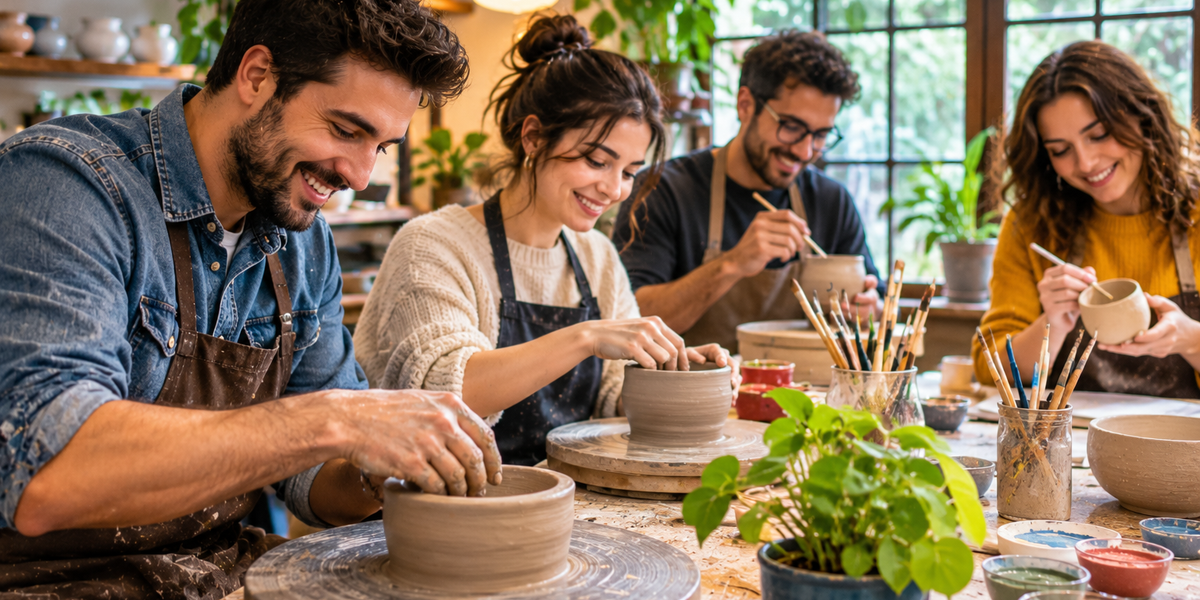
Now something quieter seems to be happening. People are knitting badly, painting without showing anyone, growing herbs on balconies, joining pottery classes, doing puzzles, learning instruments, keeping scrapbooks, developing film, baking complicated things for no particular reason, and meeting friends to play board games. The point is not necessarily to become exceptional at any of it.
The point is to have something to do that exists outside work, scrolling, and being useful.
We Got Tired of Having Everything Happen on a Screen
Modern life can involve an astonishing number of hours looking at rectangles.
Work happens on a laptop. Conversations happen through phones. Entertainment happens on televisions. Shopping happens through apps. Banking, reading the news, booking holidays, ordering food, and maintaining friendships can all happen without leaving a chair.
The convenience is undeniable, but eventually the body starts asking for something else.
Clay feels different from a touchscreen. Soil requires both hands. A guitar string pushes against your fingertips. Paint behaves unpredictably. A jigsaw puzzle occupies an actual table for several days.
Physical hobbies return us to the three-dimensional world.
After spending eight hours moving information around a screen, making something you can hold can feel surprisingly satisfying.
We Are Rediscovering the Pleasure of Being Bad at Something
Adulthood can make incompetence uncomfortable.
At work, we are expected to know what we are doing. Online, we tend to show finished results rather than embarrassing attempts. Even exercise often becomes measured by performance.
A hobby gives you permission to be terrible.
Your first ceramic bowl can be crooked. Your tomatoes can die. Your watercolor can look nothing like the photograph. You can learn three chords on a guitar and spend six months still struggling with the fourth.
Nothing catastrophic happens.
There is something liberating about participating in an activity where nobody is evaluating you and the consequences of failure are almost nonexistent.
Not Everything Needs to Become a Side Hustle
The internet created extraordinary opportunities for people to turn skills into income. But it also introduced the idea that any activity you become reasonably good at should eventually be monetized.
Someone compliments your cake and suddenly you are considering taking orders. Friends like your photographs and suggest opening a photography business. You make jewelry and immediately hear that you could sell it online.
Sometimes that is exactly how wonderful businesses begin.
But sometimes the cake can just be cake.
A hobby occupies a valuable category precisely because it does not need to generate anything except enjoyment. It does not require a growth strategy, audience, revenue target, or content calendar.
You are allowed to do something inefficiently for yourself.
Making Something Feels Different From Consuming Something
Much of modern leisure is consumption.
We watch. Scroll. Listen. Browse. Order. Stream.
None of those things is inherently bad, but they place us primarily in the role of receiving.
Hobbies reverse the direction.
You take raw materials and create something that did not exist before. A blank page becomes a drawing. Flour becomes bread. Yarn becomes something vaguely resembling a scarf. Seeds become basil. Pieces of wood become a shelf.
The result does not have to be impressive.
The satisfaction comes partly from knowing your hands were involved.
Analog Hobbies Create Natural Limits
Digital entertainment is often designed without a clear stopping point. There is always another episode, another video, another post, another recommendation.
Physical hobbies usually contain boundaries.
You finish the puzzle. The daylight disappears from the garden. Your hands get tired from knitting. The pottery class ends. You run out of paint. The bread needs an hour to rise.
These natural pauses make the experience feel different.
Instead of relying entirely on willpower to stop, the activity itself creates a rhythm.
That rhythm can be surprisingly calming in a culture built around endless feeds.
Hobbies Give the Mind Somewhere Gentle to Go
Some activities require enough concentration to interrupt anxious or repetitive thinking without demanding the intense focus of professional work.
Knitting is a good example. So is gardening. Drawing. Baking. Woodworking. Puzzles. Running. Embroidery.
Your attention becomes occupied by something specific and manageable: the next stitch, the next ingredient, the next piece, the next step.
For an hour, your world becomes smaller.
You are not solving your entire life. You are trying to keep the dough from sticking to the counter.
Sometimes that is exactly enough.
We Miss Doing Things Together
Many traditional hobbies are quietly social.
People have always gathered around activities: sewing circles, sports clubs, choirs, book groups, card games, dance classes, community gardens, workshops, fishing trips.
The activity provides a reason to meet without requiring conversation to carry the entire interaction.
This can make friendship easier, especially in adulthood when meeting new people becomes strangely complicated. Instead of arranging an ambiguous coffee with someone you barely know, you both show up every Wednesday to learn ceramics.
Over time, familiarity builds naturally.
Friendship often grows more easily when people repeatedly do something beside each other.
Hobbies Restore a Different Kind of Attention
Try scrolling while kneading bread.
It does not work particularly well.
Many physical hobbies require the kind of sustained attention that everyday digital life constantly interrupts. You have to look at what your hands are doing. You have to notice small changes. You have to remain present long enough for something to develop.
At first, this can feel surprisingly difficult.
Then it begins to feel good.
The mind settles into a slower rhythm where progress happens gradually rather than through constant novelty.
There Is Comfort in Learning Old Skills
Some of the hobbies returning to popularity are hardly new.
Sewing. Gardening. Baking. Pottery. Woodworking. Preserving food. Embroidery. Fishing. Keeping chickens. Making pasta by hand.
These activities connect modern life with skills people practiced long before they became hobbies.
For previous generations, many were necessities rather than leisure. Romanticizing that past would be misleading; washing clothes by hand is considerably less charming when there is no washing machine available.
But choosing to learn an old skill under modern circumstances offers something different.
It reminds us that we are capable of producing, repairing, growing, and making things rather than simply purchasing replacements.
A Hobby Gives You an Identity Outside Work
One of adulthood’s stranger questions is, “What do you do?”
We usually answer with our job.
Over time, professional identity can become so dominant that losing a job, changing careers, taking parental leave, retiring, or simply having a difficult period at work can destabilize our sense of who we are.
Hobbies create other answers.
You are someone who gardens. Someone who hikes. Someone who paints. Someone who sings in a choir. Someone who knows an unreasonable amount about birds.
These identities do not depend on promotions or performance reviews.
They belong entirely to you.
The Best Hobbies Produce Stories, Not Content
There is a subtle difference between documenting a life and performing one.
A hobby can easily become another opportunity to produce content. Suddenly the pottery needs photographing. The hike needs posting. The finished painting needs approval from strangers.
There is nothing wrong with sharing things you enjoy.
But some experiences become strangely precious when nobody else sees them.
The cake disappears. The flowers eventually die. The puzzle gets taken apart. The sketch stays inside a notebook.
The experience still mattered.
Perhaps even more because it did not need witnesses.
You Do Not Need to Find Your Passion
The pressure to find a perfect hobby can defeat the purpose.
You do not need to discover the activity you will practice for the next thirty years. You can take a pottery class and decide you hate pottery. You can buy cheap watercolors and use them three times. You can become obsessed with gardening for one summer and barely touch it the next.
Interests are allowed to change.
The goal is not to build another permanent identity.
It is to remain curious enough to keep trying things.
Doing Something for No Reason Might Be the Point
We spend enormous parts of adulthood doing things because they lead somewhere.
We study for qualifications. Work for salaries. Exercise for health. Network for opportunities. Save for the future. Complete tasks so we can move to the next tasks.
A hobby can exist outside that logic.
You paint because painting is enjoyable.
You walk because the evening is beautiful.
You make pasta because making pasta takes an absurd amount of time and tonight you happen to have it.
There is no larger strategy.
And perhaps that is why real-life hobbies are quietly returning. After years of optimizing our routines, monetizing our interests, tracking our progress, and turning ourselves into permanent projects, doing something simply because we like doing it feels almost radical.
Not everything has to improve your career, grow your audience, increase your income, or transform you into a better version of yourself.
Some things are worth doing because Tuesday evening is long, your phone is boring, and you would rather make something with your hands.